


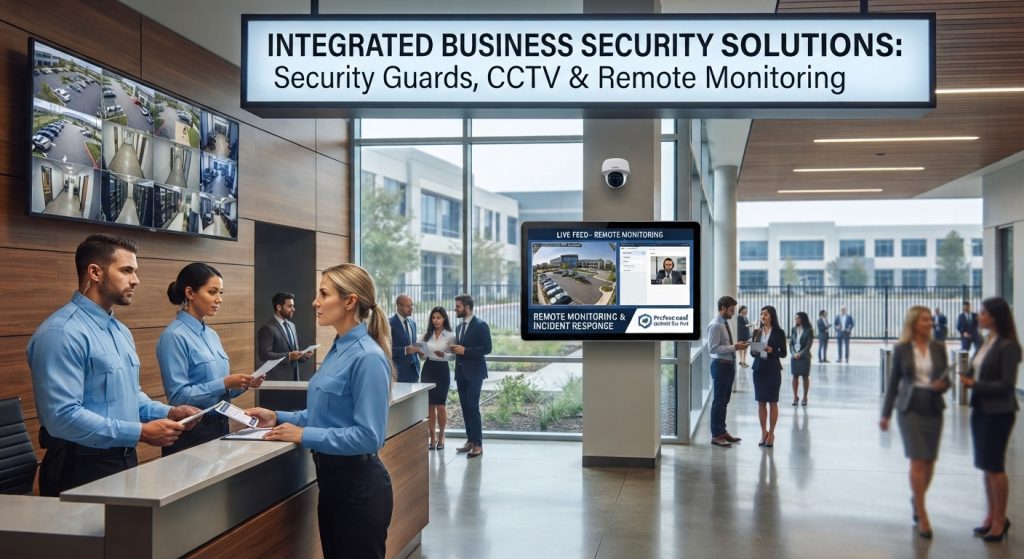
Security Guards, CCTV Cameras or Remote Monitoring: Which Security Solution Is Right for Your Business?
Protecting a business is no longer simply a choice between hiring a security guard or installing cameras.
Businesses today can choose from on-site security guards, CCTV surveillance, remote video monitoring, mobile surveillance, mobile patrols, access control, or a combination of these solutions.
So which security solution is right for your business?
The answer depends on your property’s risk level, operating hours, size, access points, previous incidents, valuable assets, and budget.
For many businesses in Edmonton and Calgary, the most effective approach may be a hybrid security solution that combines trained security personnel with surveillance technology.
At Central Protection Services Inc. (CPS), we provide security guards, CCTV surveillance, remote monitoring, mobile patrols, and integrated security solutions designed around each client’s specific requirements.
Understanding Your Main Security Options
Before deciding which option is best, it is important to understand the role each security solution plays.
Security Guards
Security guards provide a physical human presence at your property.
Depending on the assignment, guards can:
- Control access
- Verify visitors and contractors
- Conduct property patrols
- Monitor CCTV
- Respond to incidents
- Check doors and gates
- Assist employees and visitors
- Document suspicious activity
- Contact emergency services when required
- Prepare incident and daily activity reports
The greatest advantage of a security guard is the ability to observe, assess, communicate, and respond.
CCTV Cameras
CCTV cameras provide continuous visual surveillance of selected areas.
Cameras can monitor:
- Entrances and exits
- Parking lots
- Building perimeters
- Construction equipment
- Storage areas
- Loading zones
- Warehouses
- Retail areas
- Restricted locations
Recorded footage can also help businesses review incidents and maintain documentation.
However, cameras primarily provide visibility. Unless the cameras are actively monitored, someone may not become aware of an incident until after it has happened.
Remote Video Monitoring
Remote monitoring adds a human monitoring component to CCTV surveillance.
Instead of simply recording footage, cameras can be connected to a monitoring operation where alerts or selected activity can be reviewed.
Depending on the security system and agreed response procedures, monitoring personnel may:
- Review camera alerts
- Verify suspicious activity
- Contact designated personnel
- Communicate with security officers
- Initiate an agreed escalation procedure
- Request appropriate response where required
This can transform cameras from passive recording devices into part of a more proactive security system.
Security Guards vs. CCTV vs. Remote Monitoring
Each option has different strengths.
The best solution depends on what you are trying to protect and how quickly you need someone to respond.
1. Which Provides the Strongest Visible Deterrence?
Security Guards
A uniformed security guard provides an obvious physical presence.
Someone considering trespassing, theft, vandalism, or unauthorized entry can immediately see that trained security personnel are present.
This can be especially useful for:
- Retail stores
- Commercial buildings
- Construction sites
- Hotels
- Events
- Warehouses
- Residential properties
- Industrial facilities
CCTV Cameras
Visible cameras and security signage can also act as deterrents.
However, a potential intruder may not know whether the cameras are actively monitored.
Remote Monitoring
Remote monitoring strengthens CCTV by adding active review and escalation capabilities, but it still does not create the same physical presence as an on-site security officer.
Best for visible physical deterrence: Security Guards
2. Which Provides the Widest Surveillance Coverage?
One security guard cannot physically watch every part of a large property at the same time.
This is where CCTV has a major advantage.
Multiple cameras can monitor:
- Gates
- Parking lots
- Building entrances
- Equipment yards
- Storage areas
- Perimeters
- Loading areas
A properly designed CCTV system can significantly expand visibility across a large property.
Best for broad visual coverage: CCTV Cameras
3. Which Provides Immediate Human Response?
If an incident occurs while an on-site guard is present, the officer can assess what is happening and follow the site’s response procedures.
A camera cannot physically investigate an open door, speak with an unauthorized individual, provide directions during an evacuation, or check a suspicious area.
Remote monitoring can identify and escalate an incident, but a physical response may still be required.
Best for immediate on-site human response: Security Guards
4. Which Is Better for 24/7 Surveillance?
Providing a dedicated guard around the clock requires multiple shifts and continuous staffing.
CCTV systems can provide continuous visual coverage, making them valuable for properties requiring 24-hour surveillance.
Adding remote monitoring can provide an additional layer by allowing selected alerts or live activity to be assessed according to established procedures.
Best for continuous visual coverage: CCTV + Remote Monitoring
5. Which Is More Cost-Effective?
There is no universal answer.
A business that requires continuous access control may need on-site guards regardless of cost.
However, a lower-risk property that mainly requires after-hours surveillance may be able to use CCTV and remote monitoring instead of maintaining a dedicated guard throughout the entire night.
Another property may use mobile patrols to provide periodic physical verification.
The objective should not simply be to choose the cheapest security service.
The goal should be to achieve the appropriate level of protection at an efficient cost.
When Should You Choose Security Guards?
On-site security guards may be the best option when:
- Continuous physical presence is required
- Access control is important
- Employees, contractors, or visitors need verification
- Your property has experienced repeated incidents
- Valuable assets require protection
- Immediate response is important
- The property has significant public interaction
- Customer service is part of the security role
- Regular physical patrols are required
Security guards are particularly valuable where security decisions require human judgment.
When Should You Choose CCTV Cameras?
CCTV may be appropriate when:
- You need continuous visual coverage
- Your property has multiple vulnerable areas
- You need recorded footage
- You want to monitor entrances and exits
- You need coverage of parking lots or equipment yards
- Physical guard coverage alone would leave blind spots
- You want another layer of deterrence
CCTV can be particularly useful for warehouses, construction sites, commercial properties, industrial yards, retail stores, and parking facilities.
When Should You Choose Remote Monitoring?
Remote monitoring may be appropriate when:
- Your property is unattended after hours
- You already have compatible CCTV infrastructure
- You want selected camera events actively reviewed
- You need an escalation process for suspicious activity
- A permanent on-site guard is not required
- You manage multiple locations
- You want to strengthen your existing surveillance system
Remote monitoring can be particularly useful for construction sites, vacant properties, equipment yards, warehouses, commercial lots, and other after-hours environments.
What About Mobile Surveillance Cameras?
Temporary and changing sites can create additional challenges.
For example, a construction project may not have permanent electricity, internet connectivity, or finished infrastructure.
Mobile, solar-powered, or cellular surveillance systems can provide more flexible coverage.
These solutions can be useful for:
- Construction projects
- Vacant properties
- Equipment yards
- Temporary sites
- Remote locations
- Parking areas
- Special projects
As the site changes, surveillance equipment can be repositioned to protect new vulnerable areas.
Why Cameras Alone May Not Be Enough
Installing cameras does not automatically create a complete security program.
A camera may record someone entering a property, but if nobody is reviewing the footage or responding to the activity, the recording may primarily become evidence after the incident.
Businesses should therefore ask:
Who is watching the cameras?
What happens when suspicious activity is detected?
Who responds?
How quickly can someone reach the property?
What is the escalation procedure?
These questions are just as important as camera resolution or the number of cameras installed.
Why Hybrid Security Can Be the Better Solution
Businesses do not necessarily have to choose between security guards and technology.
A hybrid security solution combines multiple layers of protection.
For example:
CCTV Cameras → Detect and Record
Remote Monitoring → Verify and Escalate
Security Guards → Assess and Respond
Mobile Patrol → Conduct Physical Property Checks
Each layer performs a different function.
Together, they can create a more complete security strategy.
Example 1: Construction Site
A construction site could use:
Solar CCTV Cameras + Remote Monitoring + Overnight Security Guard + Random Mobile Patrols
Cameras monitor gates, equipment, materials, and perimeter areas.
Monitoring personnel review selected activity.
The on-site guard conducts patrols and responds according to site procedures.
Mobile patrol adds another layer of physical inspection and supervision.
Example 2: Commercial Building
A commercial office property could use:
On-Site Guard During Business Hours + CCTV + Remote Monitoring After Hours
During the day, the guard manages visitors, access control, and incidents.
After employees leave, cameras and remote monitoring continue providing surveillance.
Mobile patrols can then perform periodic physical checks.
Example 3: Retail Store
A retailer could use:
Retail Security Guard + CCTV + Loss Prevention
The security guard provides visible deterrence and response while CCTV expands coverage across the sales floor and entrances.
This creates a stronger loss-prevention program than relying on cameras alone.
Example 4: Warehouse
A warehouse could combine:
Gate Security + CCTV + Access Control + Mobile Patrol
The guard verifies authorized access while cameras monitor loading areas, inventory zones, parking areas, and exterior locations.
After-hours mobile patrols can provide additional physical inspections.
Security Technology Still Requires Good Planning
Technology is only effective when it is properly designed and maintained.
Businesses should consider:
- Camera placement
- Blind spots
- Lighting
- Image quality
- Internet or cellular connectivity
- Power availability
- Storage requirements
- Alert configuration
- Monitoring procedures
- Response protocols
For example, installing ten cameras does not necessarily mean a property is better protected than one with six strategically positioned cameras.
Security technology should be designed around identified risks rather than simply installing more equipment.
Start With a Security Risk Assessment
Before deciding between guards, CCTV, or remote monitoring, consider conducting a security assessment.
The assessment should examine:
- Previous security incidents
- Property layout
- Access points
- Operating hours
- Valuable assets
- Parking areas
- Lighting
- Existing CCTV
- Perimeter vulnerabilities
- Employee and visitor activity
- Response requirements
The results can help determine the right combination of people and technology.
Security Guards, CCTV & Remote Monitoring in Edmonton and Calgary
Central Protection Services Inc. provides integrated security solutions for businesses, construction projects, commercial properties, retailers, warehouses, industrial facilities, and other organizations throughout Edmonton, Calgary, and surrounding Alberta communities.
Our services can include:
- Professional Security Guards
- Commercial Security Guards
- Construction Site Security
- Mobile Patrol Security
- CCTV Installation
- CCTV Rental
- Temporary Security Cameras
- Solar Security Cameras
- Cellular Surveillance Cameras
- Mobile Surveillance Units
- Remote Video Monitoring
- Access Control
- Alarm Response
- Digital Incident Reporting
Rather than relying on one security measure for every property, CPS can develop a security program based on the site’s actual risks and operating requirements.
Which Security Solution Is Right for Your Business?
So, should you choose security guards, CCTV cameras, or remote monitoring?
If your property requires continuous human presence, access control, and immediate physical response, security guards may be the best solution.
If your priority is continuous visual coverage and recorded evidence, CCTV cameras may be appropriate.
If you want cameras to become part of a more proactive security system, remote monitoring can add verification and escalation.
For many businesses, however, the strongest answer may be:
Security Guards + CCTV + Remote Monitoring
A properly designed hybrid security solution combines the judgment and response capabilities of trained personnel with the visibility and coverage provided by modern surveillance technology.
Central Protection Services Inc. can assess your property and recommend a customized security solution based on your risks, operating hours, property layout, and budget.
Central Protection Services Inc.
Safety • Security • Protection
Contact CPS today to request a security assessment and customized quote for security guards, CCTV surveillance, mobile patrols, or remote monitoring in Edmonton and Calgary